
Machine intelligence · Agentic AI · Governed swarm management

Machine Intelligence Field Note

The agentic control plane architecture

A control plane does not make models more intelligent. It makes their use of enterprise systems more bounded, observable, and operable.

Enterprise

Published Updated Reviewed By LongTermIntelligence.com

Direct answer

What are the core layers of an agentic control plane?

#

A practical agentic control plane separates experience and workflow, orchestration, policy and identity, execution and tools, state and memory, evaluation, evidence, and operations. The exact components may be centralized or federated, but their responsibilities and owners should be explicit.

  • Keep the reasoning component separate from execution authority.
  • Use policy enforcement points before consequential side effects.
  • Preserve evidence across model, tool, agent, and human boundaries.

Source basis: reviewed synthesis of the strategy corpus. Report-derived claims remain subject to the verification boundary in the source library.
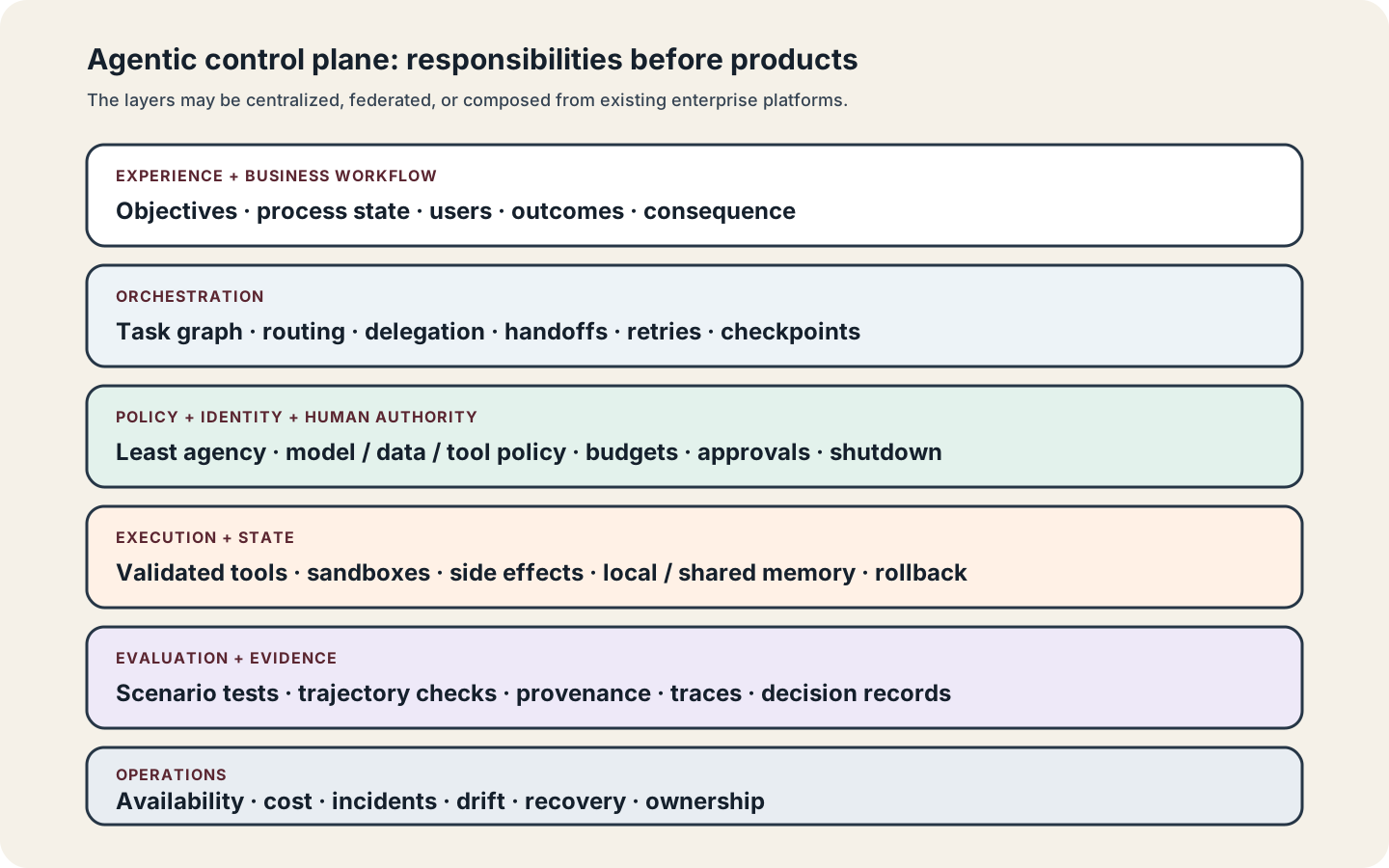
Reference diagram

Reference control-plane layers

The model shows responsibilities rather than prescribing one vendor or deployment topology.

A layered reference architecture for experience, orchestration, policy and identity, execution, state, evaluation, evidence, and operations.
Use an architecture decision record to map these responsibilities to the existing environment.

Decision paths

Control-plane capabilities

A production design makes each responsibility observable and owned.

Identity and least agency

Task-scoped identities, permissions, expiry, delegation, and revocation.

Policy and authority

Allowed models, data, tools, budgets, approval thresholds, and prohibited actions.

Orchestration and state

Task graph, handoffs, checkpoints, shared state, retries, and recovery.

Execution boundaries

Argument validation, sandboxing, idempotency, side-effect control, and rollback.

Evaluation and evidence

Release cases, production sampling, trace lineage, decision records, and exceptions.

Operations and economics

Latency, availability, cost, incident response, kill switches, and ownership.

Decision table

Centralized, federated, or embedded?

The control model should match organizational scale, risk, and existing platforms.

ModelStrengthRiskBest fit
Embedded per applicationFast and close to the workflow.Inconsistent policy, evidence, and identity across teams.Small number of bounded, low-coupling workflows.
Centralized platformConsistent policy, inventory, evidence, and operations.Bottleneck, latency, platform coupling, one-size-fits-all controls.Shared enterprise services and high cross-system risk.
Federated control planeShared standards with domain-local execution and ownership.Requires strong contracts, conformance tests, and governance.Large enterprises with multiple platforms and business domains.

Next step

Map control responsibilities to existing systems

A control-plane workshop can identify what is already provided by IAM, gateways, orchestration, observability, data, and governance platforms—and what remains missing.

Private local search

Find machine intelligence, agentic AI, swarm management, services, industries, use cases, definitions, or research

Press / to open search when focus is not in a form field.

Search runs locally against the public site index.