
Machine intelligence · Agentic AI · Governed swarm management

Machine Intelligence Field Note

OpenTelemetry for AI agents: trace the whole trajectory

Traditional application monitoring can show that a request failed. Agent observability must also show the plan, state, meaning, authorization, and effect of a multi-step trajectory.

Enterprise

Published Updated Reviewed By LongTermIntelligence.com

Direct answer

What should an OpenTelemetry trace for an AI agent capture?

#

An agent trace should connect the task, active agent and workflow versions, model calls, retrieval, messages, state transitions, tool requests, authorization decisions, human interventions, costs, errors, side effects, and final business outcome under one durable correlation context.

  • Avoid recording secrets or unnecessary sensitive content in telemetry.
  • Keep semantic attributes versioned as conventions evolve.
  • Trace evidence must support operations, evaluation, incident response, and cost attribution.

Source basis: reviewed synthesis of the strategy corpus. Report-derived claims remain subject to the verification boundary in the source library.
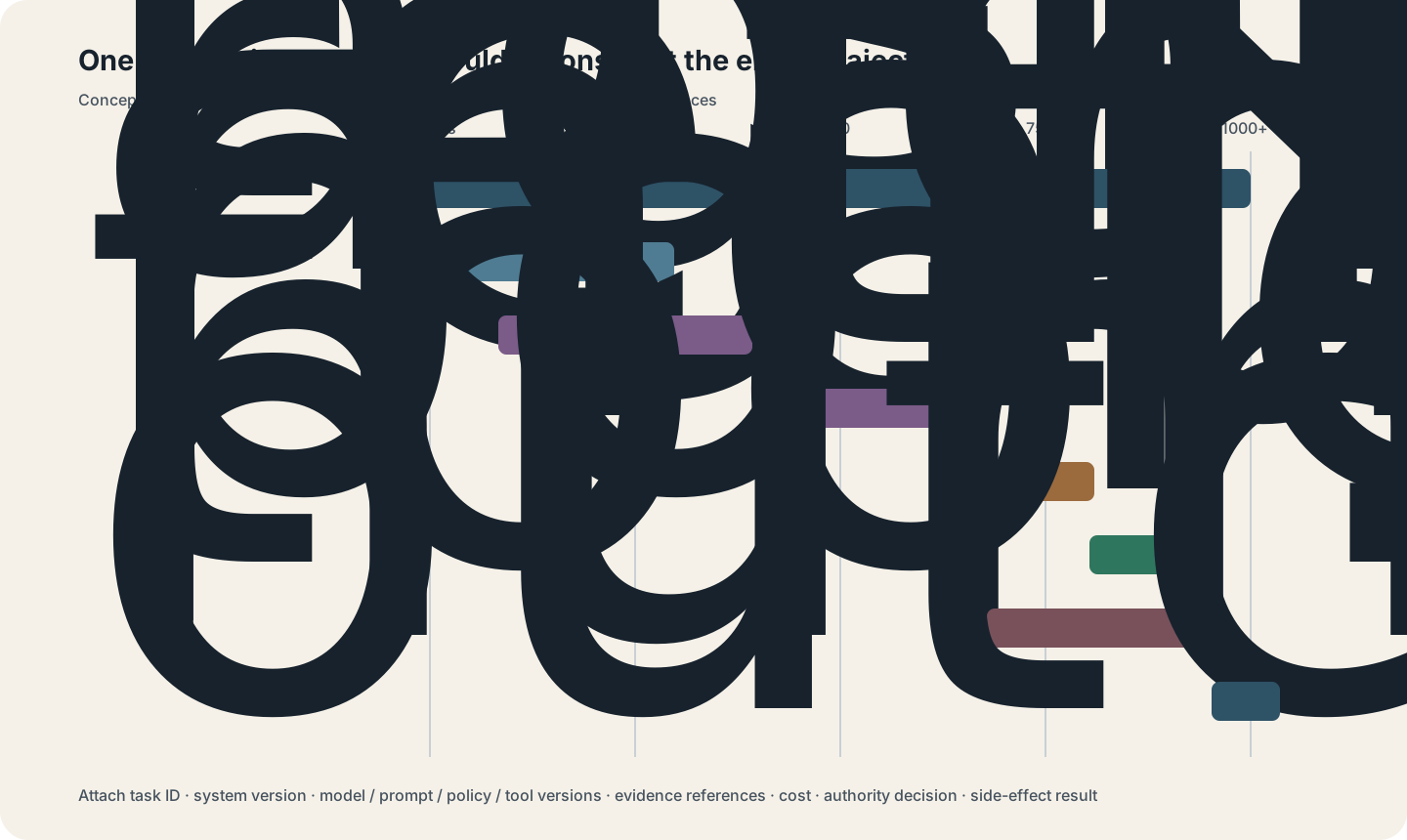
Reference diagram

A representative agent trace waterfall

One trajectory connects orchestration spans with model, retrieval, tool, policy, approval, and outcome events.

A trace waterfall showing an agent run with planner, retrieval, model, policy, tool, approval, and outcome spans.
Attribute names are conceptual; align implementation with the current telemetry conventions and privacy policy.

Decision table

Trace domains

The trace should be useful without turning sensitive prompts into an uncontrolled data lake.

DomainCaptureControl
TaskTask ID, workflow, risk tier, owner, start and completion.Use stable identifiers and minimize business payload.
VersionAgent, prompt, model, tool, policy, retrieval, state schema.Record immutable versions or hashes.
ModelProvider, model, operation, latency, tokens, errors.Redact or reference sensitive prompt and response content.
RetrievalQuery reference, source IDs, result count, provenance, staleness.Apply data classification and retention.
ToolTool, operation, arguments reference, authorization, result, side effect.Never emit credentials; store sensitive values in controlled evidence stores.
CoordinationSender, receiver, handoff contract, state version, timeout, retry.Preserve causality across asynchronous systems.
AuthorityPolicy result, requested approval, reviewer, decision, scope, override.Separate named accountability from generic “human approved.”
OutcomeQuality, business result, cost, exception, rollback, incident link.Connect technical telemetry to the actual workflow decision.

Working checklist

Observability design questions

Instrument for decisions and incidents, not only dashboards.

  • Can one correlation ID reconstruct the entire agent trajectory?
  • Can operators identify the active model, prompt, policy, tool, and state versions?
  • Can the trace distinguish a proposal from an authorized side effect?
  • Are approval, override, and shutdown events explicit?
  • Can cost be attributed to a completed or failed business task?
  • Are telemetry retention, access, redaction, and deletion policies documented?

Next step

Instrument one complete trajectory

Start with the task, plan, tool, authority, and outcome path that would be hardest to reconstruct during an incident.

Private local search

Find machine intelligence, agentic AI, swarm management, services, industries, use cases, definitions, or research

Press / to open search when focus is not in a form field.

Search runs locally against the public site index.