
Machine intelligence · Agentic AI · Governed swarm management

Machine Intelligence Field Note

Anatomy of a multi-agent cascade

Multi-agent failures are often syntactically valid and operationally successful until the wrong meaning becomes a real side effect.

Enterprise

Published Updated Reviewed By LongTermIntelligence.com

Direct answer

How does a cascading failure happen in a multi-agent system?

#

A cascade begins when one agent creates an unsupported interpretation, state, or instruction that another component accepts as valid. The error crosses handoffs, shared memory, tools, or approvals, becomes increasingly difficult to distinguish from trusted state, and produces a downstream decision or side effect.

  • HTTP success does not establish semantic correctness.
  • Every boundary needs explicit input, output, confidence, provenance, and failure behavior.
  • Containment should stop propagation before rollback becomes the only option.

Source basis: reviewed synthesis of the strategy corpus. Report-derived claims remain subject to the verification boundary in the source library.
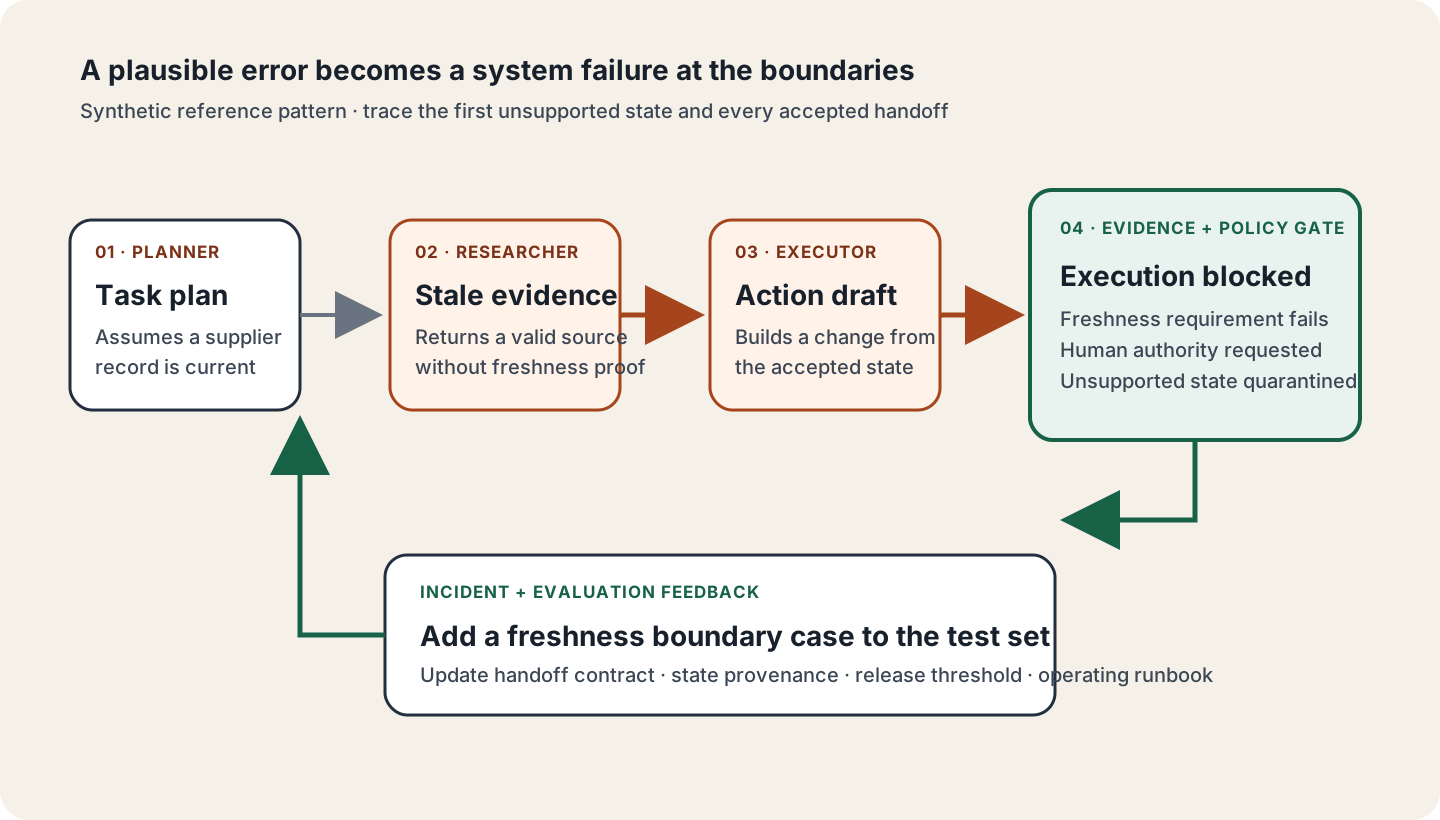
Reference diagram

A semantic cascade and containment point

The example separates trigger, propagation, amplification, side effect, and control failure.

A planner passes an unsupported assumption to a researcher, executor, and reviewer before an evidence and policy gate contains the action.
The example is synthetic and illustrates a failure pattern rather than a client incident.

Method

Reconstruct the failure path

A useful review identifies the first unsupported state and every boundary that treated it as trusted.

  1. Trigger

    Identify the input, retrieved content, stale state, tool response, or policy condition that exposed the weakness.

  2. Local error

    Record the unsupported inference, missing evidence, wrong objective, or corrupted state.

  3. Boundary crossing

    Show how the error entered another agent, tool, memory store, or human decision.

  4. Amplification

    Explain how retries, summaries, delegation, or shared state increased confidence or scope.

  5. Side effect

    Connect the semantic failure to a decision, communication, data mutation, cost, or service impact.

  6. Containment gap

    Name the missing validation, authority, isolation, circuit breaker, or shutdown mechanism.

Decision table

Semantic circuit breakers

The right control depends on where the unsupported state crosses the system.

BoundaryControl patternEvidence
Agent to agentTyped handoff contract, required source references, confidence and unknown fields.Message, schema validation, source IDs, receiving decision.
Agent to toolAllowlisted operation, argument validation, dry run, policy check, idempotency.Request, authorization, preview, returned result, side effect.
Agent to memoryProvenance, trust tier, write policy, expiry, conflict handling.Source, writer, version, timestamp, validation state.
Agent to humanConsequence summary, evidence packet, alternatives, uncertainty, explicit approval scope.Reviewer, decision, rationale, time, modified action.
Agent to external partyContent validation, disclosure, destination policy, approval, reversible staging.Approved content, recipient, channel, delivery record.

Next step

Design the boundary before adding another agent

Bring one proposed handoff and define its contract, evidence, timeout, failure state, authority, and containment behavior.

Private local search

Find machine intelligence, agentic AI, swarm management, services, industries, use cases, definitions, or research

Press / to open search when focus is not in a form field.

Search runs locally against the public site index.