
Machine intelligence · Agentic AI · Governed swarm management

Comparison · System topology

Single-agent vs multi-agent systems: choose coordination deliberately

Adding agents can create specialization and independent checks, but it also creates handoffs, shared-state problems, duplicated inference, and new failure paths.

Enterprise

Published Updated Reviewed By LongTermIntelligence.com

Direct answer

When does a multi-agent system make more sense than one AI agent?

#

Use multiple agents when the work benefits from genuinely different roles, tools, permissions, context boundaries, or independent review—and when those benefits outweigh coordination cost and failure risk. Use one bounded agent when the task can be completed with one charter, one state model, and a manageable tool set.

  • Multiple personas inside one prompt are not necessarily a multi-agent architecture.
  • Every handoff needs a contract, evidence, and failure behavior.
  • Start with one agent unless specialization has a testable advantage.

Source basis: reviewed synthesis of the strategy corpus. Report-derived claims remain subject to the verification boundary in the source library.
Decision table

Topology trade-offs

Score the actual workflow rather than assuming more agents mean more intelligence.

DimensionSingle agentMulti-agent system
CharterOne objective and one policy envelope.Specialized charters coordinated toward a shared outcome.
ContextOne working context may become broad or noisy.Context can be isolated by role but must be transferred correctly.
Tools and permissionsSimpler identity and permission design.Least-agency permissions can differ by role; identity sprawl increases.
ReviewSelf-checks or external deterministic checks.Independent reviewer agents can challenge outputs, but may share the same failure bias.
StateOne task state is easier to reason about.Shared and local state need ownership, versioning, and conflict rules.
Cost and latencyUsually fewer model calls and handoffs.Parallelism may improve speed; duplicated work and coordination add cost.
Failure behaviorFailure is more localized.Errors can cross semantic boundaries and cascade.
ObservabilityOne trajectory to reconstruct.Distributed traces must connect messages, decisions, tools, and outcomes.

Working checklist

Evidence that justifies another agent

Add a specialized agent only when at least one condition can be tested.

  • A distinct role requires a different tool or data boundary.
  • A task needs independent review with a meaningfully different rubric or model.
  • Context isolation measurably improves task quality or cost.
  • Parallel work reduces elapsed time without corrupting shared state.
  • A narrower charter makes evaluation and least-agency controls stronger.
  • The handoff contract, timeout, retry, and fallback can be specified.

Reference diagram

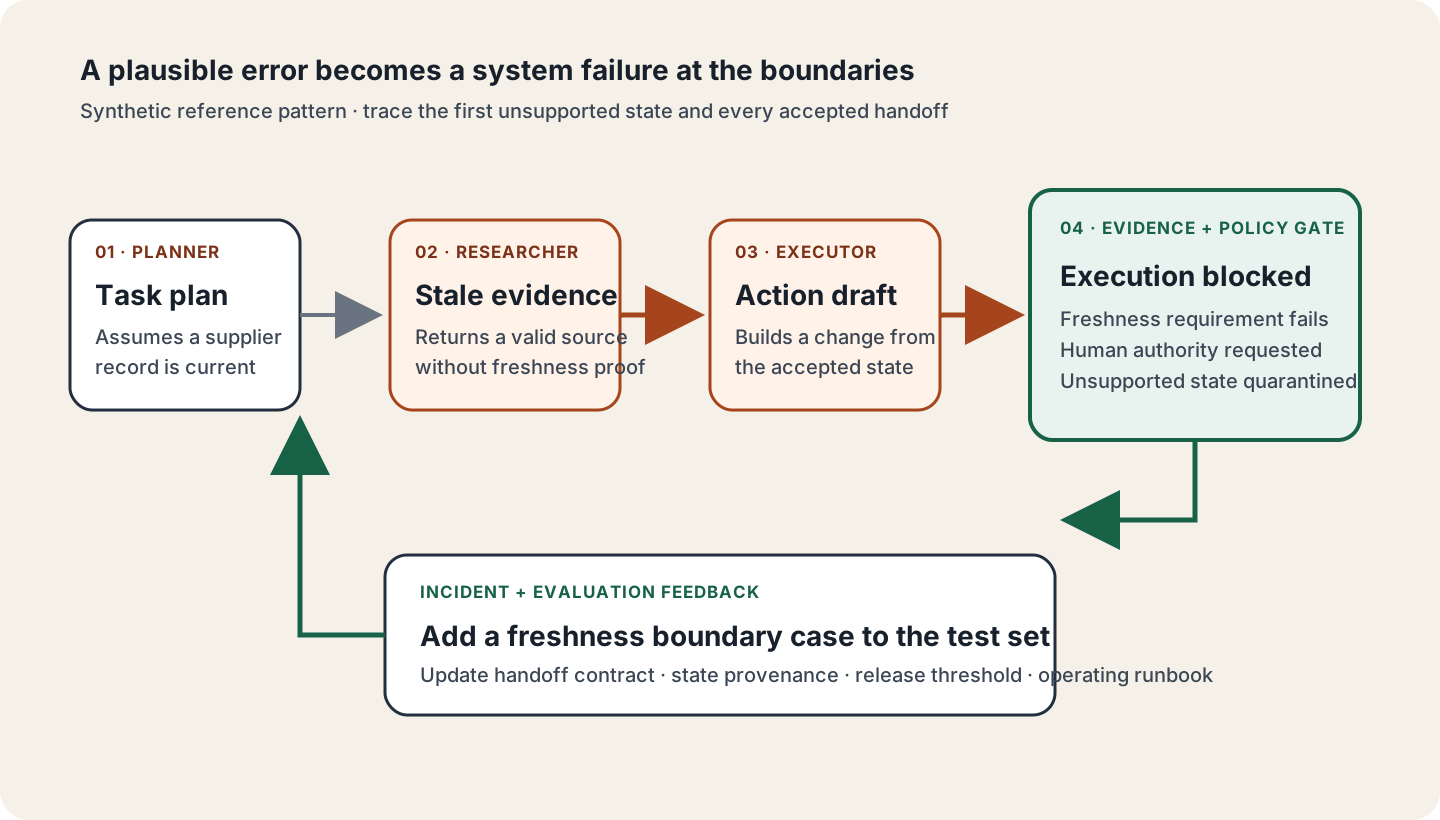
Where multi-agent failures begin

Semantic errors often appear valid to software and cross a handoff before anyone notices.

A diagram showing an unsupported assumption moving through planner, researcher, executor, and reviewer agents until a policy gate stops it.
The diagram emphasizes handoff validation and containment rather than model blame.

Next step

Prove that specialization is worth the coordination burden

Use representative cases to compare a single-agent baseline with the proposed multi-agent topology before expanding the system.

Private local search

Find machine intelligence, agentic AI, swarm management, services, industries, use cases, definitions, or research

Press / to open search when focus is not in a form field.

Search runs locally against the public site index.