
Machine intelligence · Agentic AI · Governed swarm management

Method · Identity and authority

Least-agency access review for AI agents

Least privilege limits accessible resources. Least agency also limits the objective, choices, duration, delegation, and side effects an AI agent may pursue.

Enterprise

Published Updated Reviewed By LongTermIntelligence.com

Direct answer

What is a least-agency access review?

#

A least-agency access review determines the minimum objective, context, data, tools, permissions, duration, budget, delegation rights, and side effects an agent needs for one bounded task. It also defines prohibited actions, authority checkpoints, evidence, expiration, and revocation.

  • Do not give a general-purpose agent standing access because one workflow may need it.
  • Prefer task-scoped and short-lived credentials.
  • Separate the ability to propose an action from the authority to execute it.

Source basis: reviewed synthesis of the strategy corpus. Report-derived claims remain subject to the verification boundary in the source library.
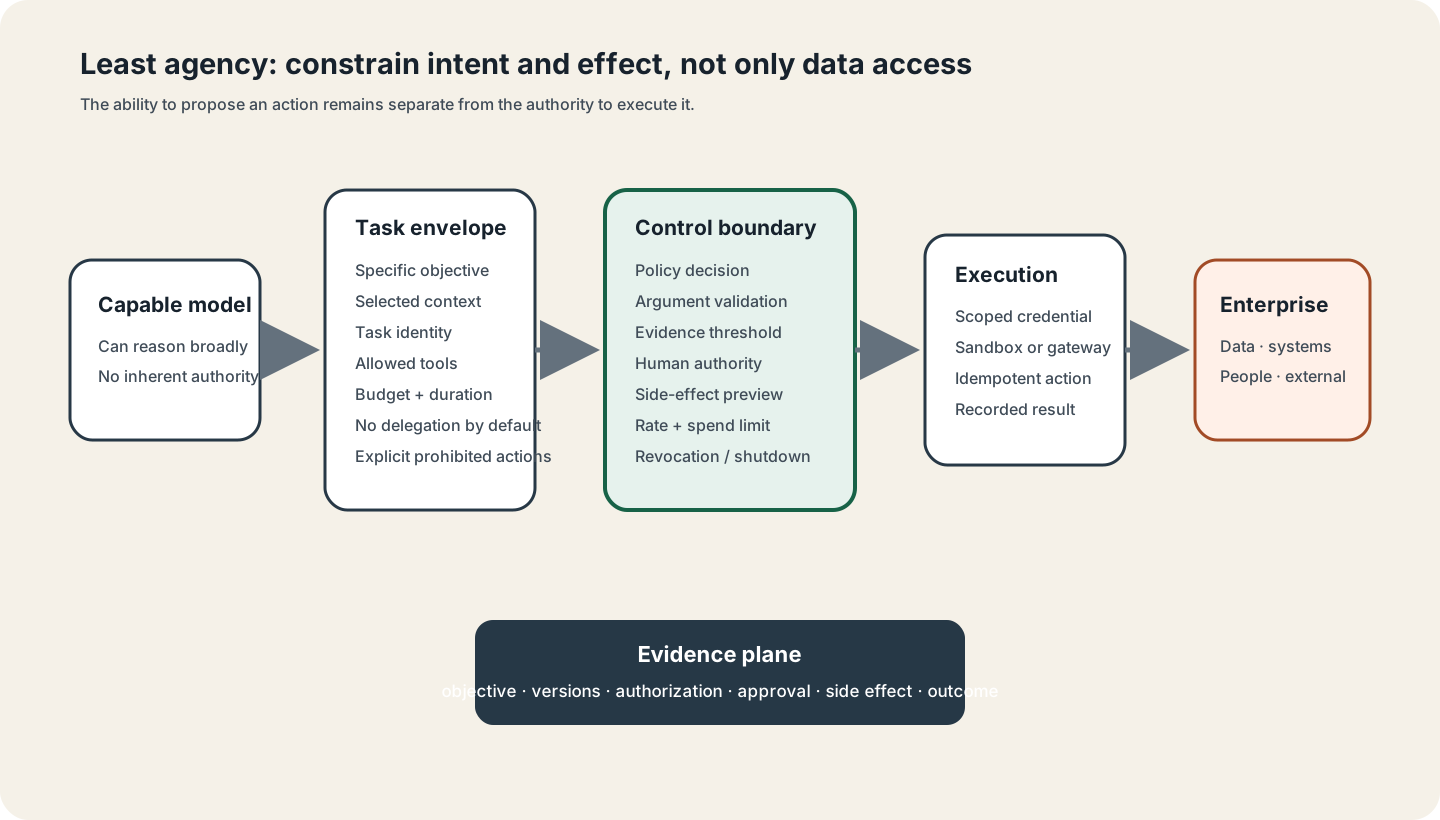
Reference diagram

From capability to authorized action

The review narrows a broadly capable model into a task-scoped actor whose action still passes policy and authority checks.

A diagram showing objective, context, identity, policy, authority, execution, and evidence boundaries around an AI agent action.
Least agency complements—not replaces—standard identity, network, application, and data security.

Decision table

Review dimensions

Each dimension should end with a decision, owner, expiry, and evidence link.

DimensionQuestions
ObjectiveWhat exact task may the agent pursue, and what adjacent goals are prohibited?
ContextWhich information is necessary now, and what must remain isolated or redacted?
IdentityIs the identity unique, attributable, task-scoped, and short-lived?
DataWhich records, fields, classifications, regions, and time ranges may be read or written?
ToolsWhich operations are permitted, with which arguments and rate limits?
Side effectsMay the agent create, modify, delete, publish, purchase, communicate, or commit?
DelegationMay it create sub-agents, call another agent, or pass credentials and state?
Budget and timeWhat token, money, compute, step, and wall-clock limits apply?
AuthorityWhich actions require review, dual control, named approval, or are never allowed?
Evidence and revocationWhat is logged, when does access expire, and how is it stopped immediately?

Editable resources

Download the least-agency review

Use the CSV during architecture, IAM, security, procurement, and release reviews.

CSV worksheet

Least-Agency Access Review

A CSV worksheet for objectives, data, tools, permissions, side effects, delegation, budgets, authority, evidence, expiry, and revocation.

Download CSV

Templates are planning aids. They are not certifications, legal advice, security guarantees, or substitutes for client-specific validation.

Next step

Reduce standing capability to bounded agency

Review one agent identity and replace broad, persistent access with task-scoped permissions, evidence, expiration, and authority boundaries.

Private local search

Find machine intelligence, agentic AI, swarm management, services, industries, use cases, definitions, or research

Press / to open search when focus is not in a form field.

Search runs locally against the public site index.