
Machine intelligence · Agentic AI · Governed swarm management

Comparison · Architecture choice

AI agents vs workflow automation: when each approach fits

Workflow automation follows explicit rules. An AI agent selects actions under uncertainty. Many production systems need both: deterministic control around a bounded model-directed step.

Enterprise

Published Updated Reviewed By LongTermIntelligence.com

Direct answer

When should an enterprise use an AI agent instead of workflow automation?

#

Use workflow automation when the inputs, rules, transitions, and exceptions can be specified reliably. Consider a bounded AI agent when the work requires interpretation, planning, tool selection, or adaptation across variable inputs—and only when evaluation and authority controls can make that discretion acceptable.

  • Do not use an agent merely because a model can complete the task in a demo.
  • Keep irreversible actions behind deterministic policy and authority checks.
  • Combine approaches when a model handles ambiguity but software enforces execution.

Source basis: reviewed synthesis of the strategy corpus. Report-derived claims remain subject to the verification boundary in the source library.
Decision table

Decision criteria

The best choice is often a hybrid rather than an all-or-nothing replacement.

CriterionWorkflow automationAI agentHybrid design
Input variabilityBest for structured, known inputs.Handles language and variable context, with uncertainty.Agent interprets; workflow validates and routes.
Decision logicExplicit rules and state transitions.Model-directed planning inside a charter.Policy defines boundaries; agent chooses bounded steps.
RepeatabilityHigh when systems and rules remain stable.Probabilistic and sensitive to context and model changes.Deterministic gates contain variability.
AuthorityUsually encoded directly in permissions and rules.Must be constrained separately from model capability.Control plane checks identity, policy, budget, and approval.
EvaluationUnit, integration, and process tests.Scenario, trajectory, tool-use, safety, and recovery tests.Shared acceptance suite covers both layers.
Operating costPredictable execution cost after implementation.Inference, retrieval, review, and evaluation costs vary.Route only ambiguous cases to the model.
Failure modeRule, integration, queue, or state failure.Semantic error, unsupported action, drift, or tool misuse.Circuit breakers and deterministic fallback paths.

Method

Use the smallest sufficient architecture

A practical sequence prevents agent washing and unnecessary operational burden.

  1. Baseline the current process

    Measure volume, time, errors, rework, exception rate, and decision consequence.

  2. Separate deterministic and ambiguous work

    Mark steps that can be encoded from those requiring interpretation or planning.

  3. Bound model discretion

    Define the data, tools, action types, budgets, and time available to an agent.

  4. Design fallback and authority

    Route uncertainty, exceptions, and consequential actions to named human roles.

  5. Evaluate against alternatives

    Test the agent, improved automation, and human-only baseline on the same cases.

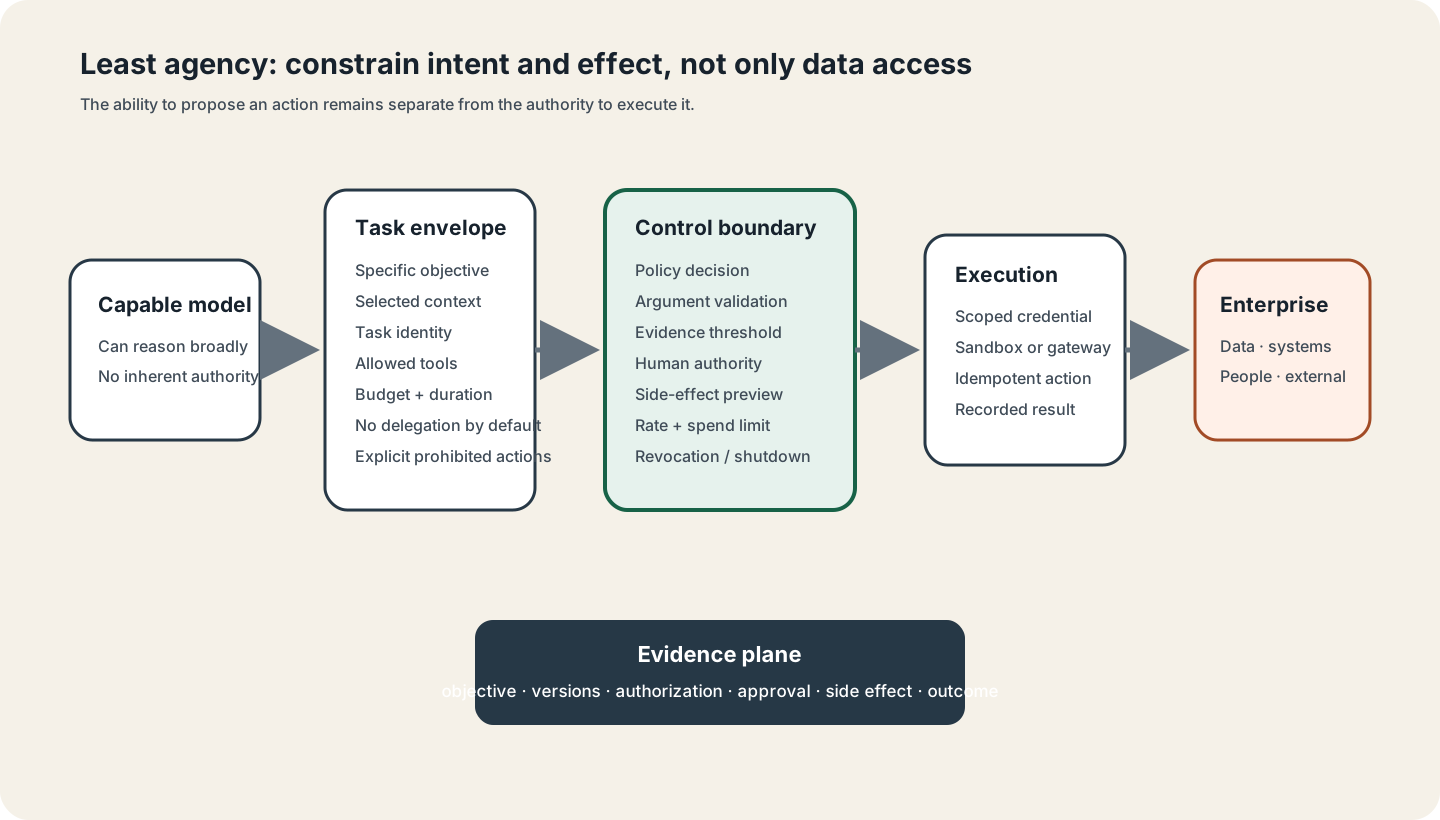
Reference diagram

A hybrid execution pattern

The model proposes or classifies; deterministic services enforce what may actually happen.

A diagram showing an AI agent proposing an action that passes through policy, authority, and execution boundaries before reaching enterprise systems.
Use the diagram as a design prompt, not as a complete security architecture.

Next step

Compare one real workflow—not two abstract categories

A readiness or architecture session can map the deterministic steps, ambiguous steps, authority boundaries, and evidence required before implementation.

Private local search

Find machine intelligence, agentic AI, swarm management, services, industries, use cases, definitions, or research

Press / to open search when focus is not in a form field.

Search runs locally against the public site index.