Machine intelligence · Agentic AI · Governed swarm management

Machine Intelligence Field Note

Standards Are Not Runtime Controls

Standards can define outcomes, requirements, vocabulary, or interfaces. They do not automatically enforce a tool boundary, reject an unsafe action, preserve a trace, recover a partial transaction, or assign human authority.

EnterpriseGovernmentPartners

Published Updated Reviewed By LongTermIntelligence.com

Direct answer

Why are standards not runtime controls?

#

A standard, framework, taxonomy, protocol, or policy source can define outcomes, requirements, risks, or interfaces. A runtime control is implemented behavior that permits, denies, limits, observes, escalates, recovers, or records an operation. The two should be traceable, but citing the source does not prove the control exists or works.

  • Translate each selected source statement into an owner, control, evidence artifact, and review method.
  • Test the control under representative and adversarial conditions.
  • Keep alignment, legal compliance, audit, certification, and system performance as separate conclusions.

Source basis: reviewed official references are listed on this page and in the source ledger. Interpretation and implementation guidance retain the stated assurance boundary.

Reference flow

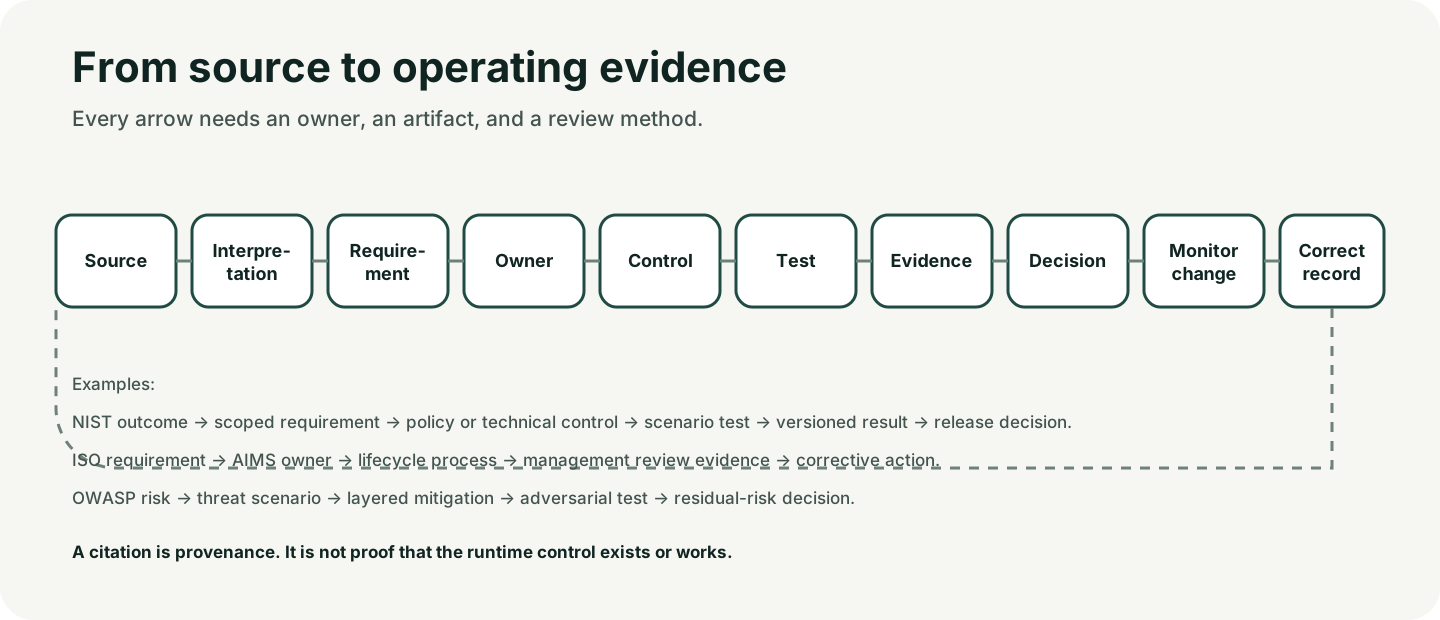
From source to operating evidence

The flow should be reviewable in both directions.

A flow from official source through interpretation, requirement, owner, control, test, evidence, decision, monitoring, and correction.
No arrow may be replaced by a marketing claim.

Translation discipline

A nine-step path from source to assurance

Each step can fail independently.

  1. Source

    Name the authoritative document, version, date, status, and scope.

  2. Interpretation

    Explain what applies, what is optional, and where qualified legal or assurance review is needed.

  3. Requirement

    Write a testable organizational or system statement.

  4. Owner

    Assign implementation, evidence, review, and residual-risk responsibility.

  5. Control

    Implement preventive, detective, responsive, or recovery behavior.

  6. Test

    Exercise representative, edge, failure, adversarial, and change scenarios.

  7. Evidence

    Retain current, version-linked artifacts and results with known limitations.

  8. Decision

    Approve, condition, remediate, suspend, replace, or stop.

  9. Monitor and correct

    Observe production, review after change, and publish corrections when source or guidance changes.

Common category errors

Claims that collapse distinct conclusions

Replace broad assurance language with the exact evidence-backed statement.

Weak claimProblemStronger form
“NIST compliant”The AI RMF is voluntary and the statement does not identify version, scope, outcomes, or evidence.“Mapped selected AI RMF 1.0 outcomes to the named system; gaps and review date are documented.”
“ISO 42001 certified architecture”ISO/IEC 42001 concerns an organizational management system; certification requires the applicable process.“Architecture evidence supports the organization’s AIMS controls; certification status is stated separately.”
“OWASP secure”A Top 10 taxonomy is not a security audit or guarantee.“Threat model and tests cover the listed ASI categories shown in the evidence register.”
“MCP-governed”Protocol conformance does not establish business authorization or safe tool use.“MCP messages pass through named identity, policy, evaluation, and execution controls.”
“Fully observable”Telemetry coverage can have blind spots and does not equal correctness.“The listed spans and events are captured at the stated sampling, redaction, and retention levels.”

Primary-source basis

Official source ledger

Each record includes publisher, source type, status, reviewed date, summary, and use boundary.

National Institute of Standards and Technology · Official Framework Hub

NIST AI Risk Management Framework

NIST's voluntary framework for incorporating trustworthiness considerations into the design, development, use, and evaluation of AI systems.

Status
Current With Revision Underway
Published
2023-01-26
Reviewed
2026-08-01

Use boundary: Use as risk-management guidance; do not describe alignment as certification or legal compliance.

Open official source

International Organization for Standardization · Official Standard Page

ISO/IEC 42001:2023 — AI management systems

Requirements and guidance for establishing, implementing, maintaining, and continually improving an AI management system within an organization.

Status
Current
Published
2023-12
Reviewed
2026-08-01

Use boundary: Do not claim certification unless an accredited audit and certification process has been completed.

Open official source

International Organization for Standardization · Official Standard Page

ISO/IEC 42006:2025 — bodies providing audit and certification of AI management systems

Requirements intended to support consistent and credible audit and certification of AI management systems against ISO/IEC 42001.

Status
Current
Published
2025
Reviewed
2026-08-01

Use boundary: This standard concerns certification bodies; it is not itself an organizational certification.

Open official source

OWASP GenAI Security Project · Official Security Taxonomy

OWASP Top 10 for Agentic Applications

A community-developed taxonomy covering ten major agentic application risk areas, from goal hijacking and tool misuse through memory poisoning, cascading failures, and rogue agents.

Status
Current
Published
2025-12-09
Reviewed
2026-08-01

Use boundary: Use as a threat-oriented taxonomy and mitigation aid, not as a certification or guarantee of security.

Open official source

Model Context Protocol · Official Protocol Specification

Model Context Protocol Specification — 2026-07-28

The reviewed MCP specification defines an open protocol for connecting language-model applications with contextual resources, prompts, and tools through host, client, and server roles.

Status
Current Reviewed Version
Published
2026-07-28
Reviewed
2026-08-01

Use boundary: MCP is an interoperability protocol, not a complete agentic control plane, governance program, or security guarantee.

Open official source

OpenTelemetry · Official Specification Hub

OpenTelemetry semantic conventions for generative AI systems

Official semantic-convention material for interoperable telemetry describing generative AI operations.

Status
Evolving
Reviewed
2026-08-01

Use boundary: Record the exact convention version implemented because names and stability levels can evolve.

Open official source

Official-source citations establish provenance and scope. They do not establish LongTermIntelligence.com certification, endorsement, legal advice, client outcomes, or a guarantee that a control is effective.

Evidence review

Turn one broad alignment claim into an inspectable record

Select a framework outcome, standard requirement, threat category, or policy statement and trace it to the live system.

Private local search

Find machine intelligence, agentic AI, swarm management, services, industries, use cases, definitions, or research

Press / to open search when focus is not in a form field.

Search runs locally against the public site index.