
Machine intelligence · Agentic AI · Governed swarm management

Method · Evaluation operations

Continuous agent evaluation plan

Offline tests support a release decision. Production evidence reveals new states, drift, incidents, and exceptions that must improve the next evaluation set.

Enterprise

Published Updated Reviewed By LongTermIntelligence.com

Direct answer

What should a continuous AI agent evaluation plan include?

#

A continuous agent evaluation plan should define the system and versions in scope, representative scenarios, expected outcomes, step and trajectory metrics, policy and authority checks, cost and latency measures, sampling, human review, thresholds, release and rollback rules, drift detection, incident feedback, and accountable owners.

  • Evaluate the end-to-end task, not only the final response.
  • Use deterministic checks where possible and model-based judging where necessary.
  • Tie every threshold to a decision and an owner.

Source basis: reviewed synthesis of the strategy corpus. Report-derived claims remain subject to the verification boundary in the source library.
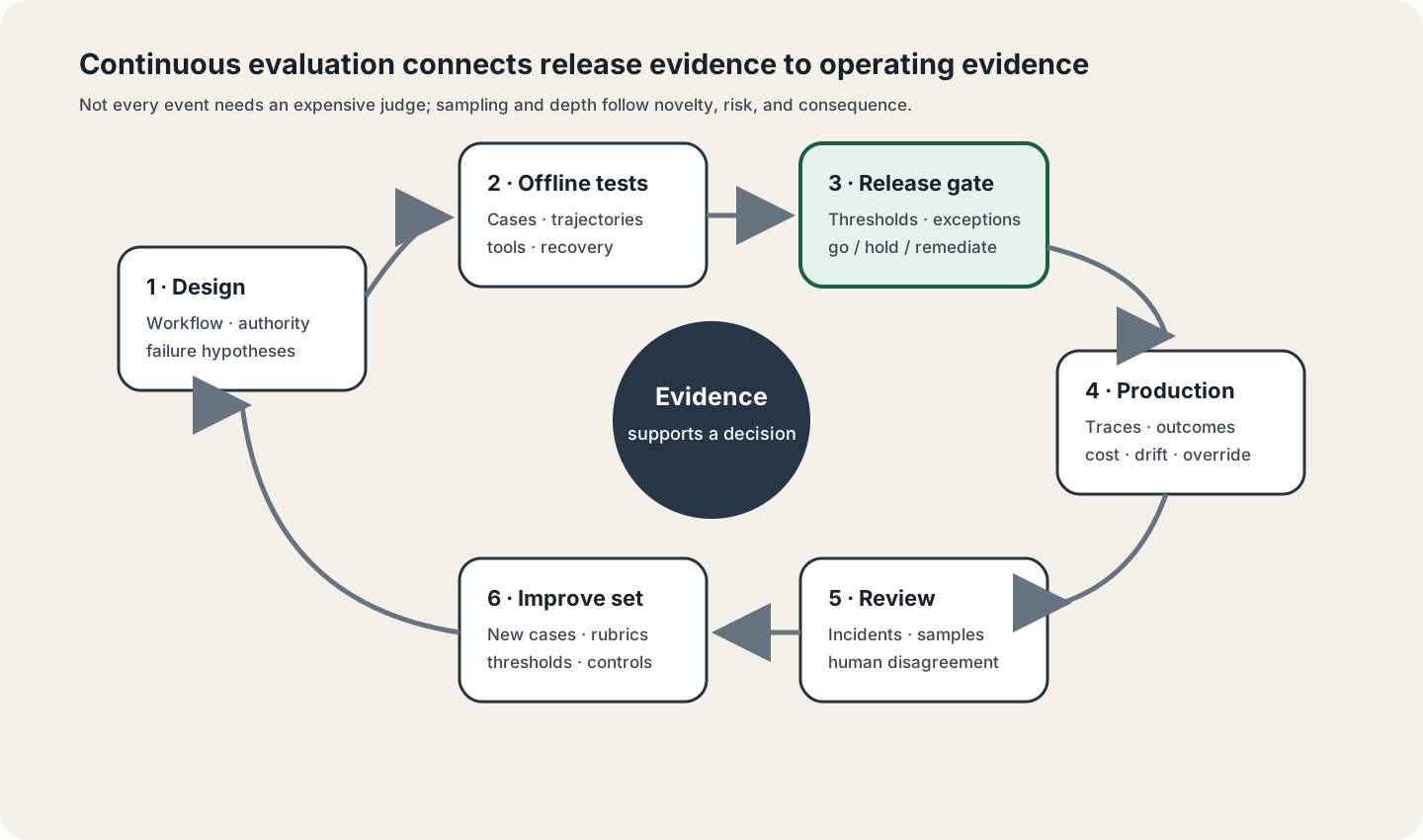
Reference diagram

Evaluation is an operating loop

Production evidence returns to the scenario library, rubrics, thresholds, and release decision.

A loop from design through offline testing, release gate, production observation, incident review, and test-set improvement.
Sampling and evaluation depth should reflect risk, volume, novelty, and consequence.

Decision table

Evaluation layers

No single metric can establish that an agentic workflow is dependable.

LayerExamplesDecision supported
Task outcomeCompletion, correctness, service quality, user or process result.Does the workflow create the intended value?
TrajectoryPlan adherence, unnecessary steps, loops, recovery, delegation.Did the system reach the outcome acceptably?
Tool useSelection, arguments, authorization, evidence, side effects.Did each action remain valid and bounded?
Grounding and stateSource support, provenance, memory consistency, stale context.Was the decision based on current, permitted information?
Policy and authorityProhibited action, approval, escalation, override, shutdown.Did the system preserve human accountability?
OperationsLatency, availability, cost, token use, queue, retry, incident.Can the system operate inside service and budget limits?
Equity and impactOutcome distribution, exceptions, affected groups, accessibility.Are risks or service failures concentrated or hidden?

Working checklist

Sampling and threshold questions

Make the monitoring plan proportional and explainable.

  • Which events are evaluated every time because their consequence is high?
  • Which low-risk events can be sampled, and how is the sample selected?
  • What triggers deeper review: novelty, disagreement, drift, cost, override, or incident?
  • Which metrics are deterministic, human-reviewed, or model-judged?
  • How are evaluator versions and disagreements recorded?
  • Which threshold blocks release, triggers rollback, or requires an authority decision?

Editable resources

Download the evaluation-plan worksheet

Use the CSV to map scenarios, measures, sample rules, thresholds, owners, evidence, and actions.

CSV worksheet

Continuous Agent Evaluation Plan

A CSV worksheet for scenarios, metrics, sampling, thresholds, release decisions, production signals, and ownership.

Download CSV

Templates are planning aids. They are not certifications, legal advice, security guarantees, or substitutes for client-specific validation.

Next step

Connect evaluation to release and operations

A review can turn scattered benchmarks into a representative, decision-linked evaluation and production-monitoring plan.

Private local search

Find machine intelligence, agentic AI, swarm management, services, industries, use cases, definitions, or research

Press / to open search when focus is not in a form field.

Search runs locally against the public site index.